
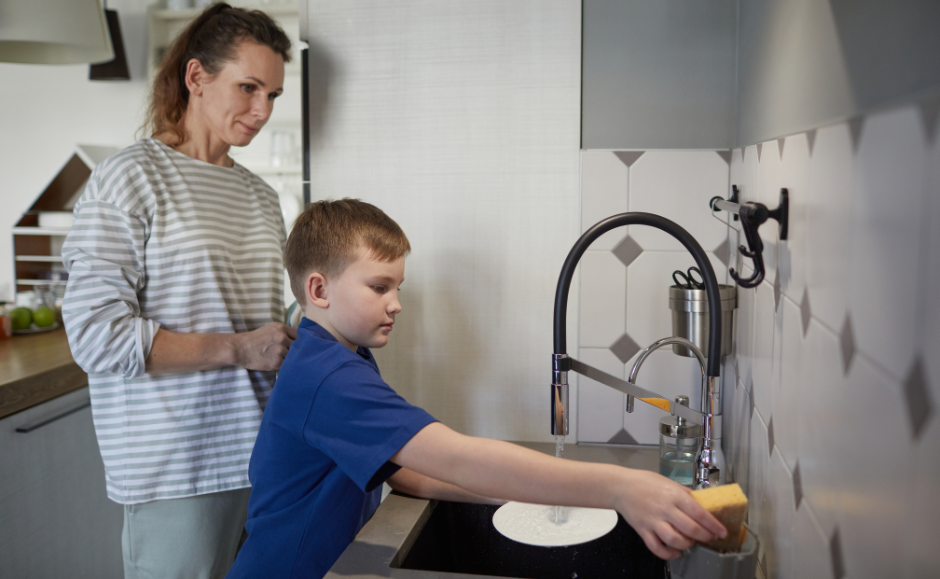
If your child can use a skill at school but struggles to use it at home, that is not a step backward. It is a normal part of learning. Skills become reliable when students practice them in more than one place, across real moments and real routines.
At Alpha School in Jackson, New Jersey, we teach social, emotional, and functional life skills in ways that make sense for learners who need targeted support. But the most significant breakthroughs often happen when families reinforce the same tools after school, in low-pressure, everyday moments.
Below are five practical ways to help social and life skills stick at home. Along the way, you will see links to related Alpha School resources you can explore for deeper guidance.
1. Pick one skill to focus on each week
It is tempting to try to improve everything at once. That usually creates stress for everyone. Choose one priority skill and maintain it for 7 days.
Examples of weekly skills:
- Self-advocacy, asking for help, or asking for a break
- Flexible thinking, trying a different way
- Conversation, greeting, and responding
- Independent routines, packing a bag, or cleaning up
- Emotion regulation, calming the body before problem-solving
If you want to align your weekly focus with how we teach these skills at school, explore our Social Skills Program. For functional goals that support independence at home and in the community, see the Life Skills Program.
2. Use one shared phrase that becomes the cue
Skills stick faster when the cue words stay the same across settings. Pick a short phrase and use it consistently at home, especially when the skill is needed.
Family-friendly cues:
- What is your next step
- Use your help words
- Try a second way
- Pause and reset
- Show me your plan
Using consistent language supports social-emotional growth, which is a key part of our SEL approach. Learn more about SEL at Alpha School.
3. Practice in low-pressure moments, not only during problems
Most families practice skills only when something is going wrong. That can make the skill feel like punishment. Instead, rehearse the same skill during calm moments so it becomes familiar.
A simple example:
- If the weekly skill is asking for help, practice it while cooking.
- If the weekly skill is flexible thinking, practice it during a game.
- If the weekly skill is conversation, practice it during a short walk.
One parent-friendly approach is the two-minute reset. You say the cue phrase, model the skill once, then your child tries it. Praise the attempt, even if it is not perfect.
If your child benefits from structure around planning and follow-through, this related post may help.
4. Make success visible with a tiny scoreboard
Many students benefit from seeing progress. Keep it simple and positive. Track one behavior connected to the weekly skill.
Examples to track:
- Asked for help without melting down
- Tried a second way once
- Used a calm strategy before talking
- Completed the routine with one reminder
Aim for two to five wins a day. When you hit the goal, celebrate with something small and meaningful.
Low lift celebrations:
- Pick the music for dinner
- Choose the family game
- Extra time on a favorite activity
The purpose is not reward control. The purpose is confidence and clarity.
For more parent-focused home strategies that complement school-based learning, see the article.
5. Build one real-life routine where the skill must happen
Skills stick when they are connected to real responsibilities. Choose one daily routine where your child can predictably practice the skill.
Ideas:
- Getting ready for school
- After school snack and check in
- Homework start routine
- Chores and clean up
- Bedtime routine
Keep the routine short. Keep expectations clear. If the routine falls apart, reset and restart tomorrow. Consistency beats intensity.
If you are looking for an option that extends social skill practice beyond the school day, learn about our after-school program here.
A quick example you can borrow
Here is a simple after-school routine that reinforces multiple skills without feeling like therapy.
- Step one, arrival and decompress
Ten minutes of quiet activity or movement - Step two, one-minute check-in
Pick a feeling word or show a feeling using a color - Step three, one life skill task
Pack tomorrow's bag, set out clothes, or help with one household job - Step four, one social connection moment
A short conversation prompt at the table: What was one good moment today? Who did you talk to? What did you do when something felt hard? - Step five: Celebrate the effort
Name the win you saw: You paused and tried again. You used your help words. You stayed with it. This routine works because it is short, predictable, and repeatable.
A final note for families
The goal is not to run a school at home. The goal is to create a bridge. When a student practices the same skill in small, real moments throughout the week, the skill becomes part of who they are, not something they do only in one building.
Parents and Guardians: https://alphaschool.com/for-parents/
Parent Resources and Support: https://alphaschool.com/for-parents/parent-resources/
Self Advocacy: https://alphaschool.com/empowering-special-needs-students-through-self-advocacy/

Alpha School a private special education school in New Jersey
Our mission at the Alpha School of Jackson, NJ, located just minutes off of Route 9 and Route 195 in Ocean County, is to help all of our special needs students with the learning, social, language, and behavioral support they deserve. Our highly skilled staff are committed daily to helping each student become the best they can while providing a safe and nurturing educational environment.
We would be more than happy to discuss your child’s specific needs and challenges, so please call us at 732.370.1150, with any questions. To get started, please contact your District's Case Manager.
— John Gonzalez, Principal-Alpha School, Jackson, NJ